
The Great Spectrum Mismatch
Why America's Broadcast Towers Are Sitting on Billions in Hidden Value — And What It Will Take to Unlock It

Across the United States, a quiet anomaly sits buried in the balance sheets of the nation’s largest television broadcasters. Companies like Nexstar Media Group, Gray Television, and Sinclair Broadcast Group own something extraordinarily valuable: Federal Communications Commission broadcast licenses — the legal right to operate television transmitters on specific frequencies in specific markets. These licenses constitute the very foundation of their businesses. Without them, a television station is nothing more than a building full of cameras and a tower with no signal to transmit.
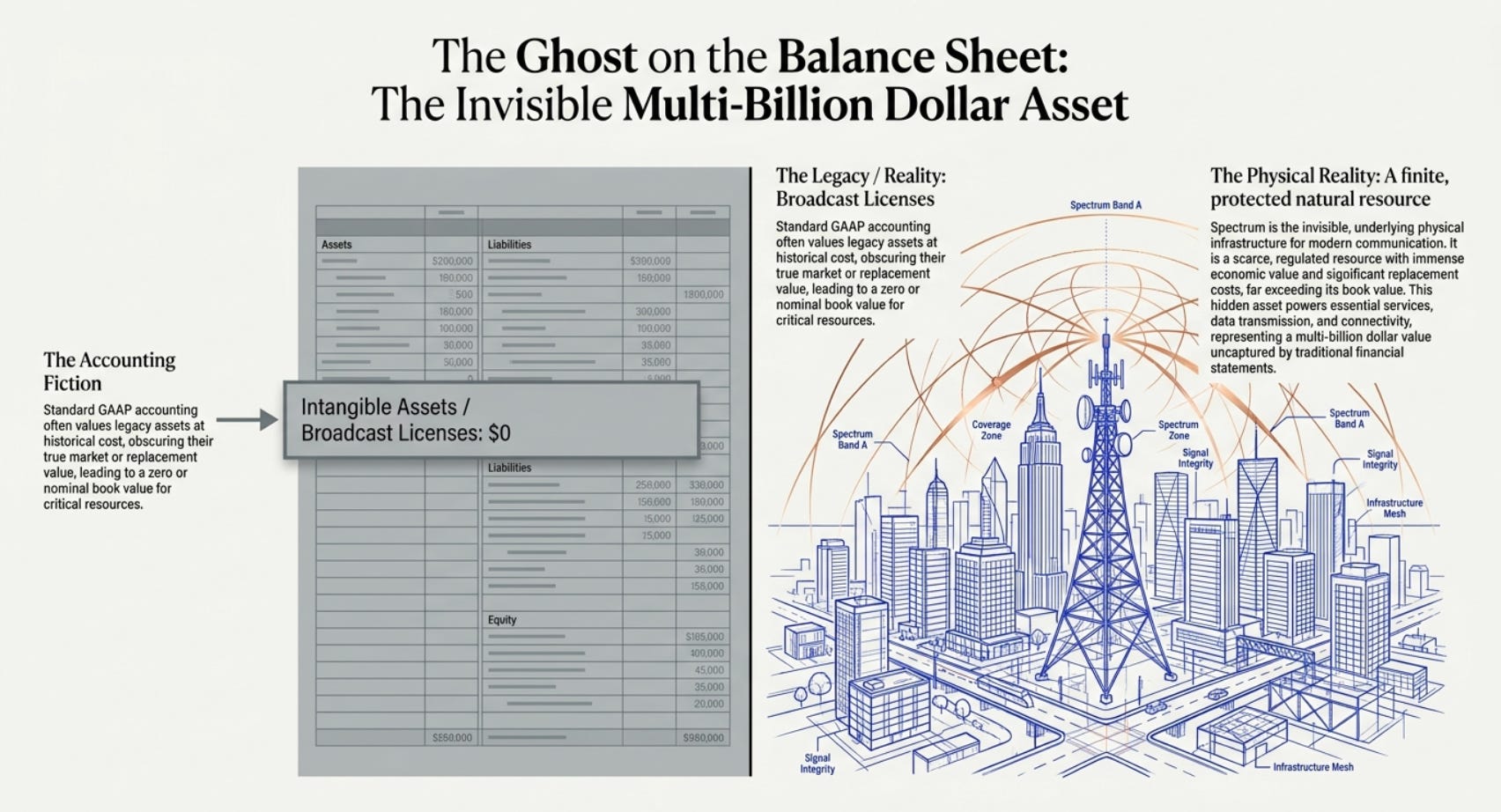
Yet here is the peculiarity: on their books, these licenses are carried at values that bear almost no relationship to what the open market has repeatedly demonstrated they are worth. Some licenses sit at precisely zero dollars. Others are recorded at purchase prices from acquisitions completed decades ago. None reflect the billions of dollars that wireless carriers and the U.S. government itself have paid for comparable spectrum rights in arms-length transactions over the past two decades.
This white paper explores the anatomy of that discrepancy — not through the lens of discounted cash flow models, price-to-earnings multiples, or Wall Street forecasting frameworks, but through the eyes of a business owner who understands what it would actually cost to replace these assets today. We will trace how a quirk of accounting rules, combined with the peculiar history of American broadcasting regulation, has created a genuine value arbitrage — one that several confirmed catalysts now appear poised to unlock.
The Hidden Value In Plain Sight
What a Broadcast License Actually Is
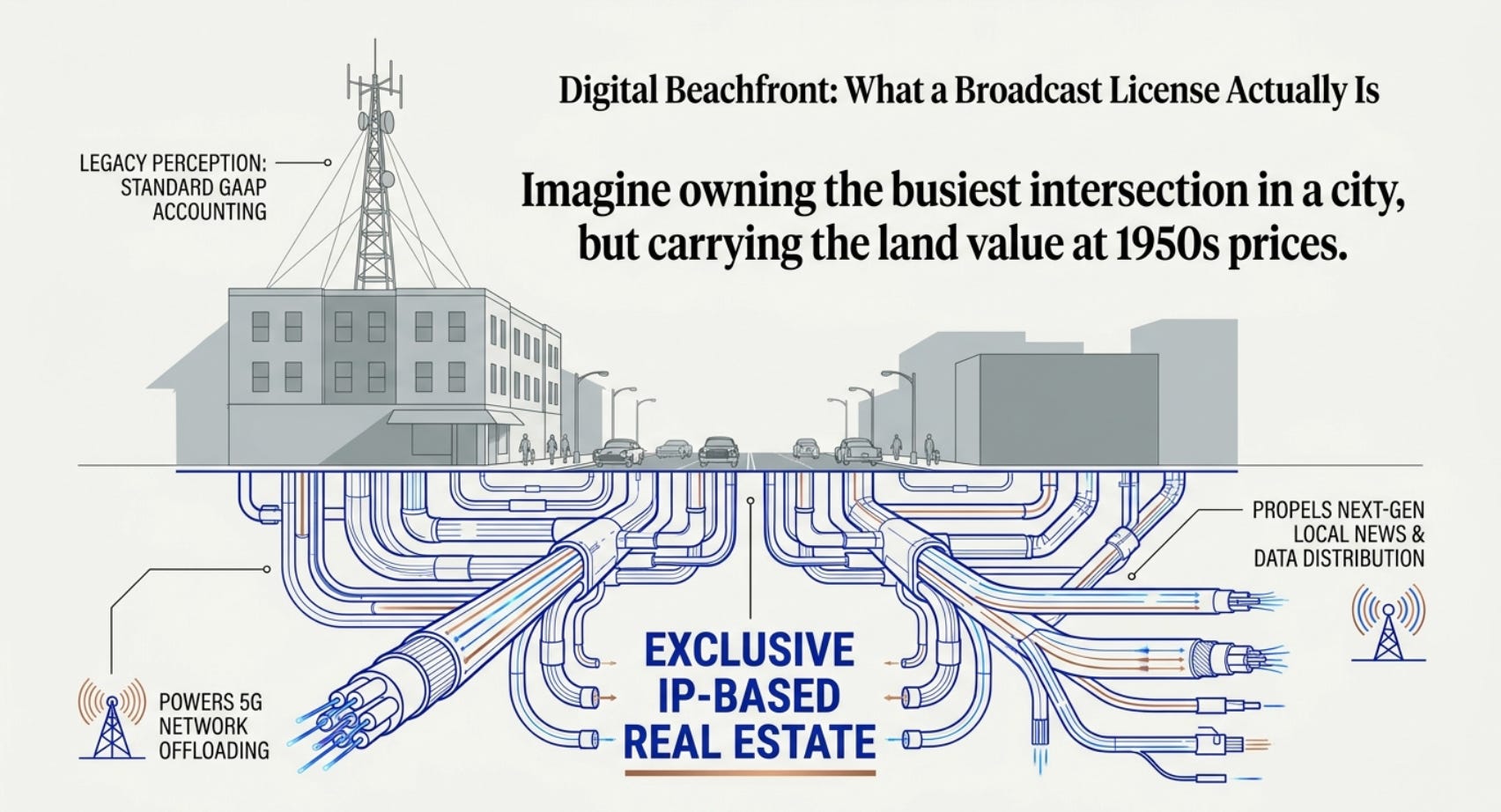
Imagine you own a plot of land at the busiest intersection in a major city — a piece of real estate that no one else can replicate. The government granted you that land decades ago for free, and under the rules of the system, you get to keep it indefinitely so long as you continue using it. You can build on it, generate income from it, sell it to someone else, or lease portions of it. But on your personal balance sheet, you carry it at either zero or whatever you paid for it when you last bought a neighboring plot in 1995.
That, in essence, is the position of every major television broadcaster in America with respect to its FCC spectrum licenses.
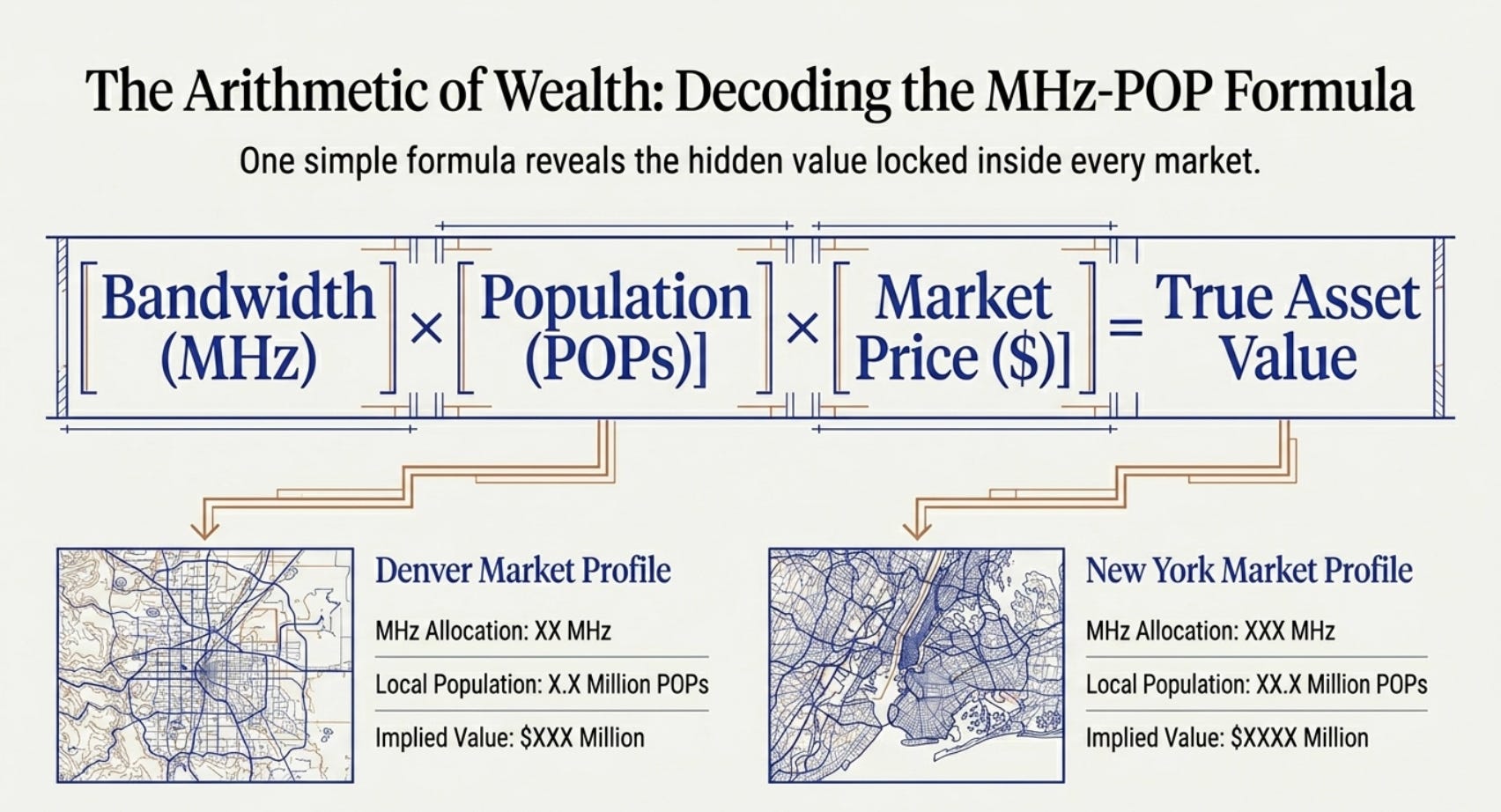
These licenses are not mere pieces of paper. They are exclusive rights to use a specific slice of the electromagnetic spectrum — a finite, government-allocated natural resource that underlies everything from television broadcasting to mobile phone service to military communications. Each license covers a defined geographic area and a defined frequency band. The standard industry metric for valuing these rights is dollars per megahertz of bandwidth per person covered, expressed as $/MHz-POP.
When the FCC conducted its landmark Broadcast Incentive Auction in 2017 — an event that would ultimately redistribute a significant portion of the television broadcast band to wireless broadband providers — television broadcasters who chose to sell their spectrum rights back to the government realized proceeds that, for many, exceeded the entire market value that public equity markets had assigned to their companies.
The Auction That Changed Everything
The 2017 FCC Incentive Auction was a landmark event in telecommunications, effectively a massive “repacking” of the airwaves. To understand why it was so complex, we first need to look at the two gears that made the machine turn.
Reverse vs. Forward Auctions: The Basics
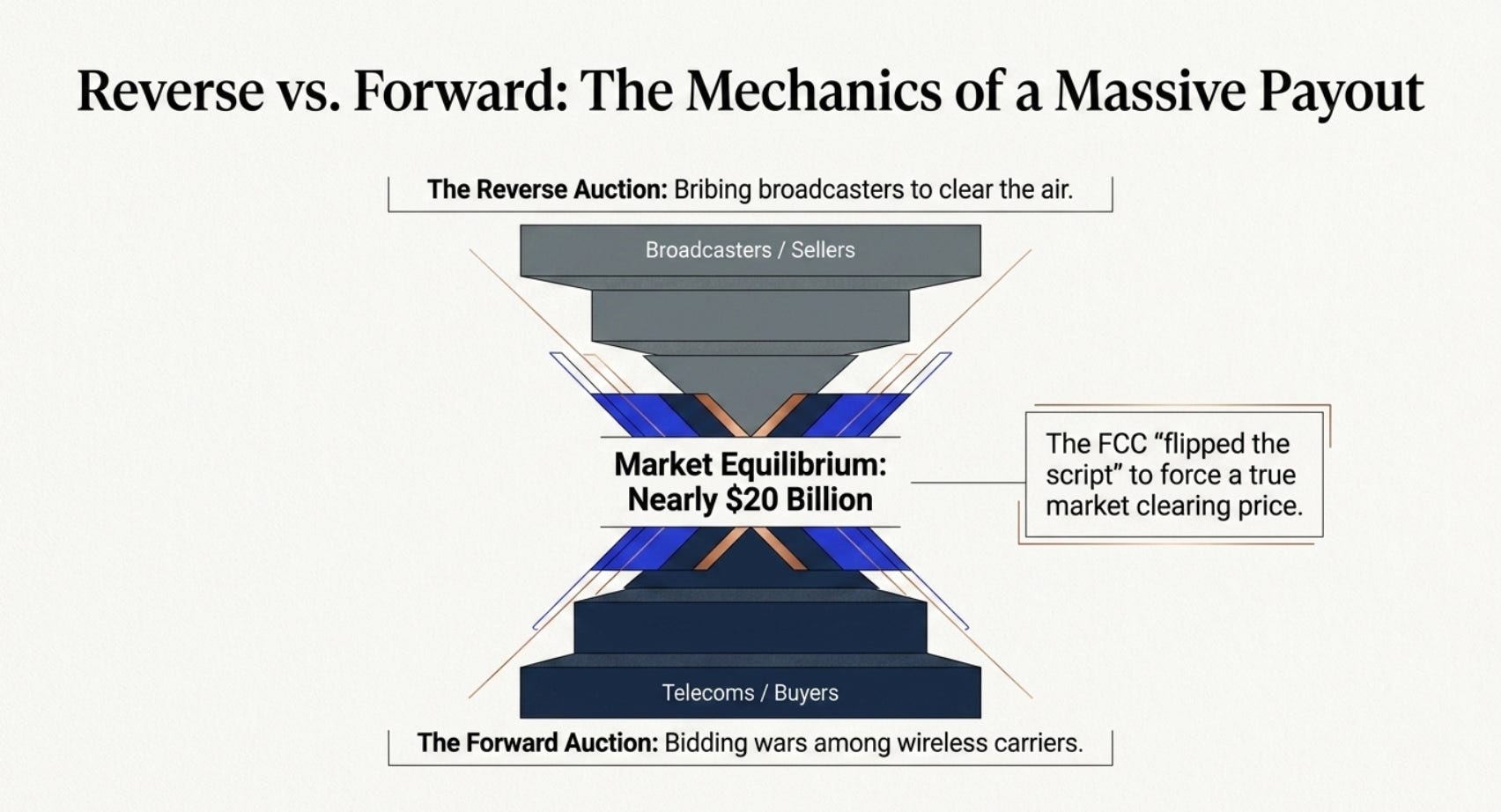
In a typical auction, you have one seller and many buyers competing to pay the highest price. The Incentive Auction was unique because it used two different directions to find a market equilibrium.
Forward Auction (The Standard Way): This is what most people recognize. There is one seller (the FCC) and many buyers (wireless carriers like T-Mobile). Bidders compete against each other, driving the price up until only the highest bidders remain.
Reverse Auction (The “Buy-Back”): Here, the roles are flipped. There is one buyer (the FCC) and many sellers (TV broadcasters). The FCC offers a high price to buy back spectrum rights, and then gradually lowers that price in rounds. Broadcasters must decide if they are willing to “sell” their airwaves at the lower price. If they say no, they keep their station but lose out on the payout. This allows the buyer to find the lowest price a seller is willing to accept.
The results were staggering by any measure.
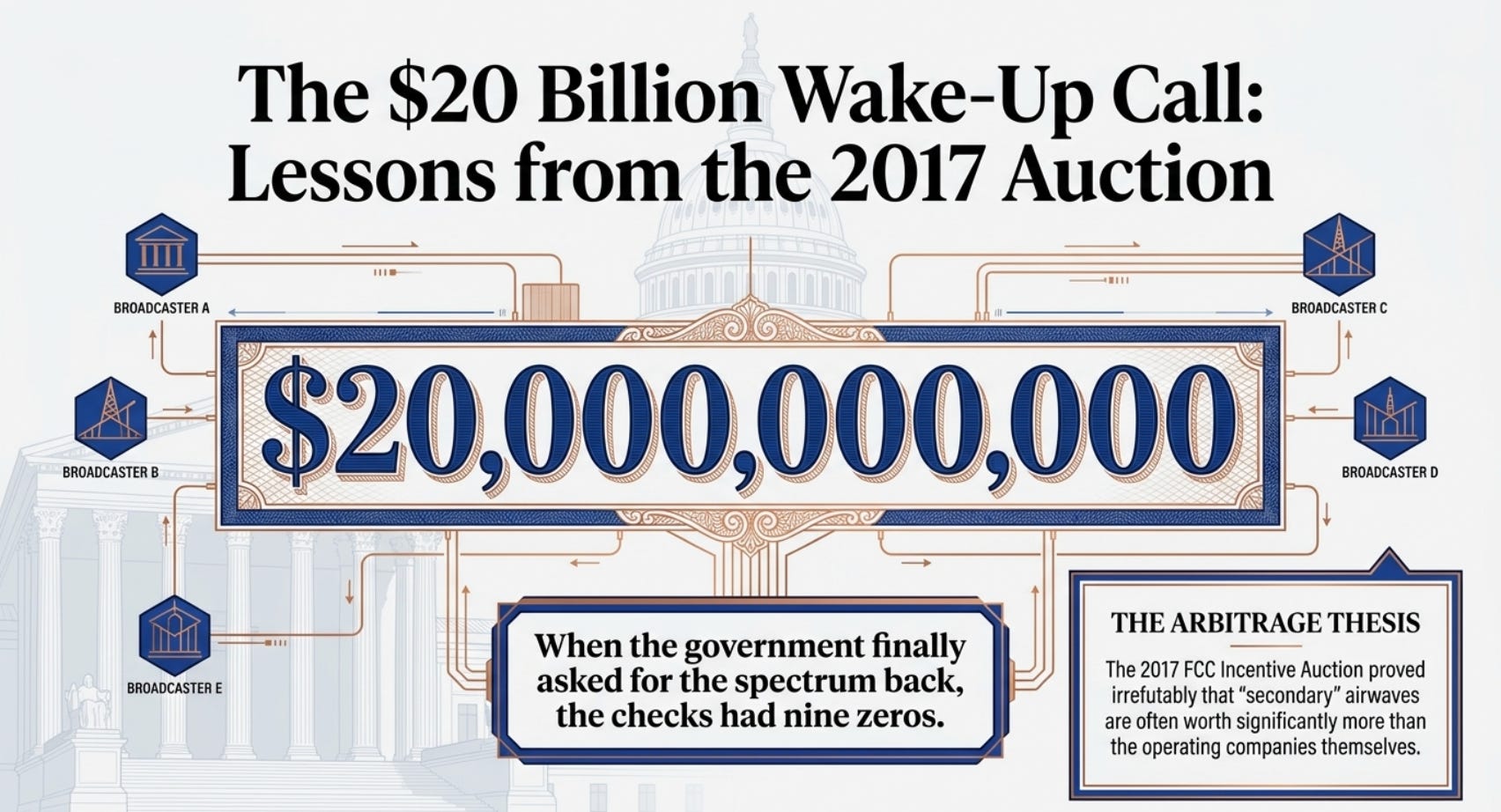
In the reverse auction, 175 television stations collectively pocketed $10 billion for spectrum rights—assets many had used for decades under licenses originally granted for free. The payouts were transformative: the largest single check reached $304 million, while 36 stations (including 11 non-commercial, educational outlets) walked away with over $100 million each.
On the flip side, the forward auction proved just how hungry the market was for low-band “beachfront” spectrum. Wireless carriers and private bidders paid $19.8 billion for 70MHz of licensed airwaves, marking the second-largest haul in FCC history. Nationwide, the price averaged $0.93 per MHz-POP, though competition in the top 40 metropolitan markets pushed that figure to $1.31.
The spending was dominated by two major players: T-Mobile, which led the pack with an $8 billion investment, and DISH Network, which committed $6.2 billion to secure its future in the wireless landscape.
These are not theoretical numbers. They represent actual cash that changed hands between sophisticated, arms-length counterparties in a transparent auction process. They tell us, with precision, what the market is willing to pay for broadcast-quality spectrum when given the opportunity.
And yet, for the broadcasters who chose not to participate — who retained their licenses and continue operating their television stations — those same licenses remain on their books at values that are, in many cases, a tiny fraction of what the auction demonstrated they could fetch.
Why the Books Tell a Different Story
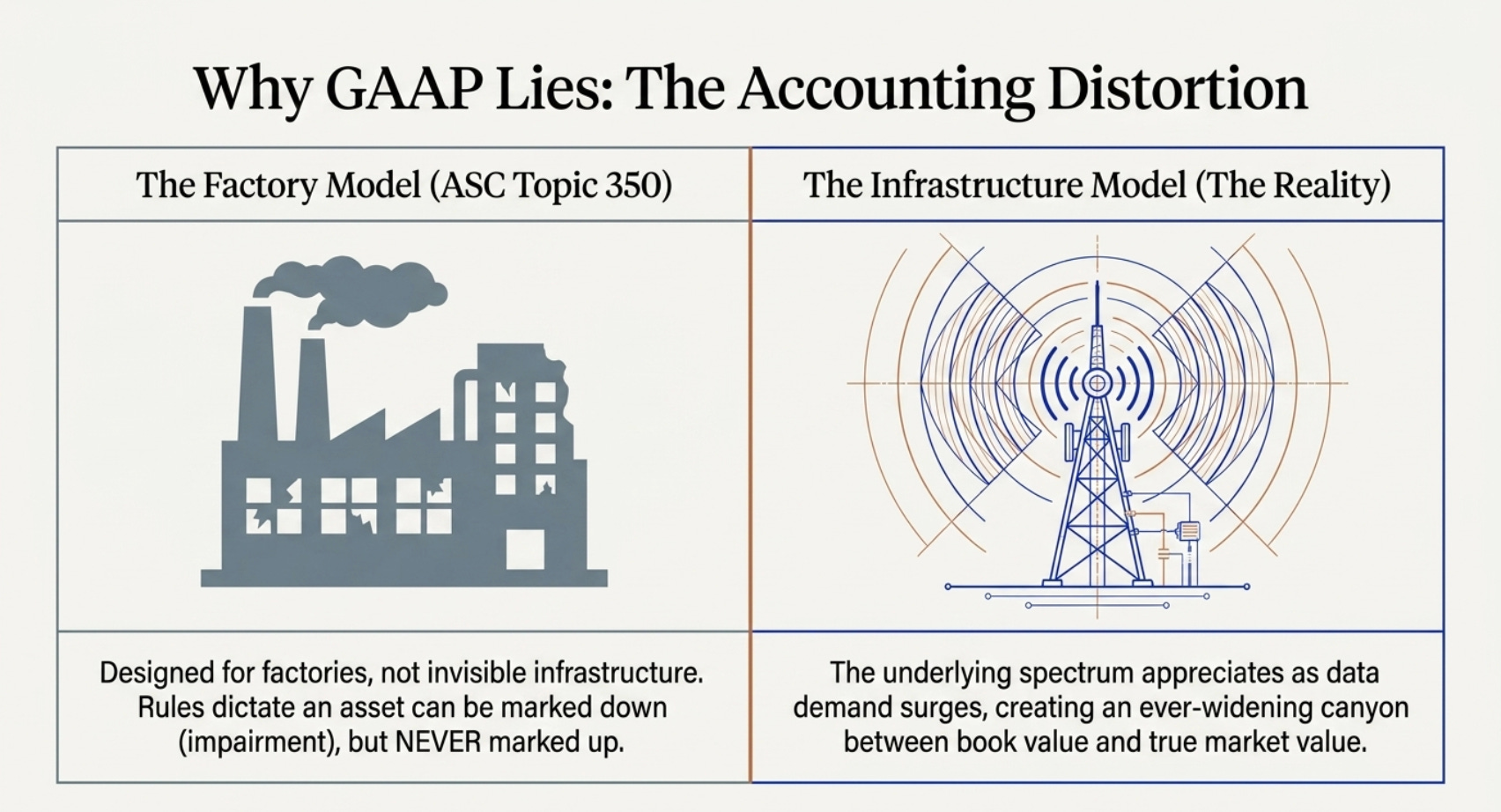
To understand the discrepancy, one must understand the accounting rules that govern how these assets are treated under Generally Accepted Accounting Principles (GAAP).
Under ASC Topic 350, FCC broadcast licenses are classified as indefinite-lived intangible assets. They are not amortized — meaning their carrying value is not systematically reduced over time — but they are subject to annual impairment testing. If an impairment test determines that the fair value of a license has fallen below its carrying value, a write-down is recorded. But critically, if the fair value has risen — which, as the 2017 auction demonstrated, has been the case for many broadcast licenses — no upward adjustment is permitted.
Furthermore, the method by which licenses are initially recorded on the balance sheet depends entirely on how they were obtained. Original broadcast licenses granted by the FCC during the analog era — often issued at no cost to the broadcaster — are carried at zero. Licenses acquired through the purchase of a television station are recorded at their allocated purchase price within that specific transaction. The result is a patchwork: a license acquired in a 1995 station deal sits at its 1995 allocation; a license acquired in a 2015 deal sits at its 2015 allocation; a license granted for free in 1952 sits at zero.
None are marked to current market comparables.
This accounting treatment is perfectly legal and entirely consistent with GAAP. But for anyone trying to understand what a television station group is actually worth, it creates a profound distortion. The single most valuable asset on the enterprise’s economic balance sheet is either invisible or dramatically understated on its accounting balance sheet.
How a Business Owner Values The Asset
Wall Street analysts and investment bankers have their own frameworks for valuing broadcasting companies. They build discounted cash flow models projecting advertising revenue, retransmission consent fees, and political advertising cycles. They apply enterprise value-to-EBITDA multiples derived from comparable public company trading ranges. They stress-test assumptions about cord-cutting, audience fragmentation, and the secular decline of linear television. They produce target prices and issue buy, hold, or sell recommendations.
A business owner — someone who actually operates television stations, understands the regulatory landscape, and has watched the spectrum market evolve over decades — approaches valuation from an entirely different direction.
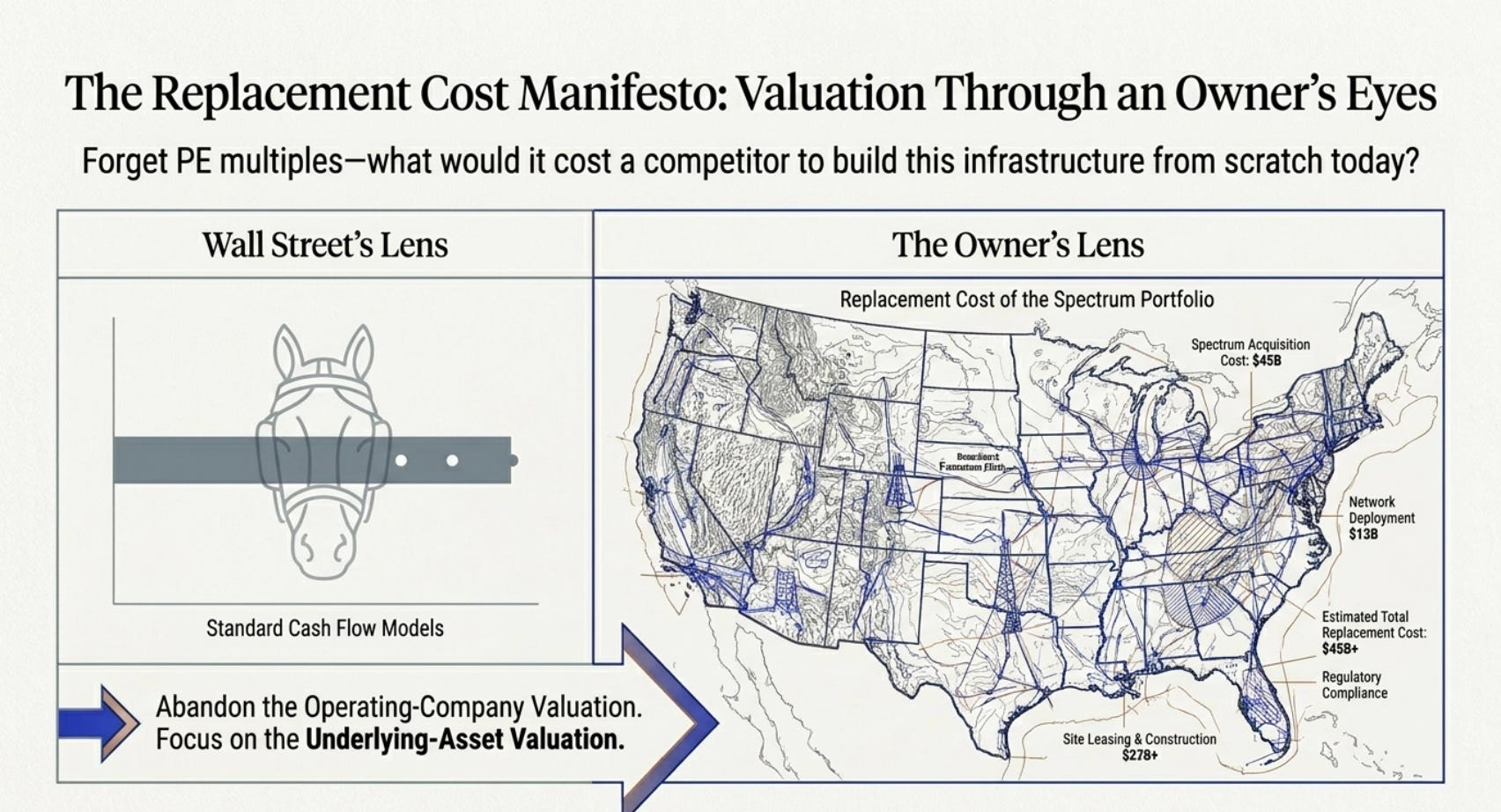
The business owner asks a simpler, more fundamental question: What would it cost to replace this asset today?
This is not an academic exercise. It is the most practical question one can ask about any asset. If you own a warehouse, what would it cost to build an equivalent warehouse on equivalent land today? If you own a patent, what would a competitor pay to develop an alternative technology? If you own an FCC broadcast license covering 6 MHz of spectrum reaching 10 million people in a top-20 market, what would it cost to acquire equivalent spectrum rights in that market through any available channel?
The answer, based on the best available evidence from actual transactions, is clear: far more than the carrying value on the books.
The Replacement Cost Framework
Let us work through a simplified example to illustrate the business owner’s lens.
Consider a hypothetical television station in a market like Denver, Colorado — a top-20 designated market area with approximately 1.8 million television households, translating to roughly 4.5 million people in the coverage area. The station operates on a 6 MHz channel in the UHF band. Its broadcast license was originally granted by the FCC decades ago and is carried on the books at zero, or perhaps at a few million dollars allocated from a station acquisition in the 1990s.
To value this license on a replacement cost basis, a business owner would look at the MHz-POP math: 6 MHz of bandwidth multiplied by approximately 4.5 million people covered equals 27 million MHz-POPs. At the 2017 auction’s national average of 0.93 per MHz−POP, the implied value would be approximately $25 million. At the top 40 market average of 1.31 per MHz−POP, the value would be approximately $35 million.
And that is for a single station. Nexstar Media Group, the largest television station group in the United States, owns, operates, and provides services to more than 200 stations across 116 markets, reaching approximately 39% of all U.S. television households.
What the Carriers Have Actually Paid
The 2017 auction is not the only data point. The secondary market for spectrum licenses — private transactions between wireless carriers, or between carriers and speculators who acquired spectrum at auction — provides an ongoing record of what sophisticated buyers are willing to pay.
In September 2023, T-Mobile entered into an agreement to acquire 600 MHz spectrum licenses from Comcast in a deal valued at up to $3.3 billion. T-Mobile had earlier acquired 600 MHz spectrum from Columbia Capital for $3.5 billion, covering 108 million people — roughly one-third of the U.S. population — in a deal that further validated the pricing established at auction.
Looking further back, the 2008 auction of 700 MHz spectrum — which had been vacated by television broadcasters as part of the digital television transition — saw Verizon pay an average of 1.10 per MHz-POP for its winnings, with AT&T paying 3.15 per MHz-POP for its more selectively targeted licenses. The Chicago license alone sold for $892 million, translating to 9.19 per MHz-POP — a reminder that in the most densely populated markets, spectrum values can reach multiples of the national average.
None of this is reflected on the balance sheets of broadcasters who hold comparable — and in many cases superior — low-band spectrum that propagates further and penetrates buildings better than the mid-band frequencies that have commanded such high prices in recent auctions.
Case Study: Gray Television — The $2 Billion Question
The story of Gray Television offers perhaps the most vivid illustration of the value arbitrage embedded in broadcast spectrum — and the painful consequences when debt, rather than assets, dictates a company’s fate.
Development: Building an Empire of Airwaves
Gray Television, founded in 1946 by James Harrison Gray as Gray Communications Systems, grew over decades from a single station into one of America’s largest television broadcasters. By 2024, the company owned or operated 180 stations across 113 markets, generating $3.6 billion in annual revenue.
Like its peers, Gray had been an active consolidator during an era of industry roll-up. Each acquisition brought new stations, new markets, and new FCC licenses onto the balance sheet — recorded at whatever portion of the purchase price was allocated to the licenses at the time of each deal. The cumulative carrying value of these licenses on Gray’s books reflected a mixture of acquisition-date allocations stretching back years, bearing no relationship to what comparable spectrum had fetched in the 2017 auction or subsequent secondary-market transactions.
When the Market Lost Sight of the Assets
By 2023, Gray Television found itself in a difficult position. The company had taken on significant debt to fund its acquisition strategy. As interest rates rose and advertising markets softened — particularly in the off-cycle years between elections, when political advertising spending plummets — the company’s equity value came under severe pressure.
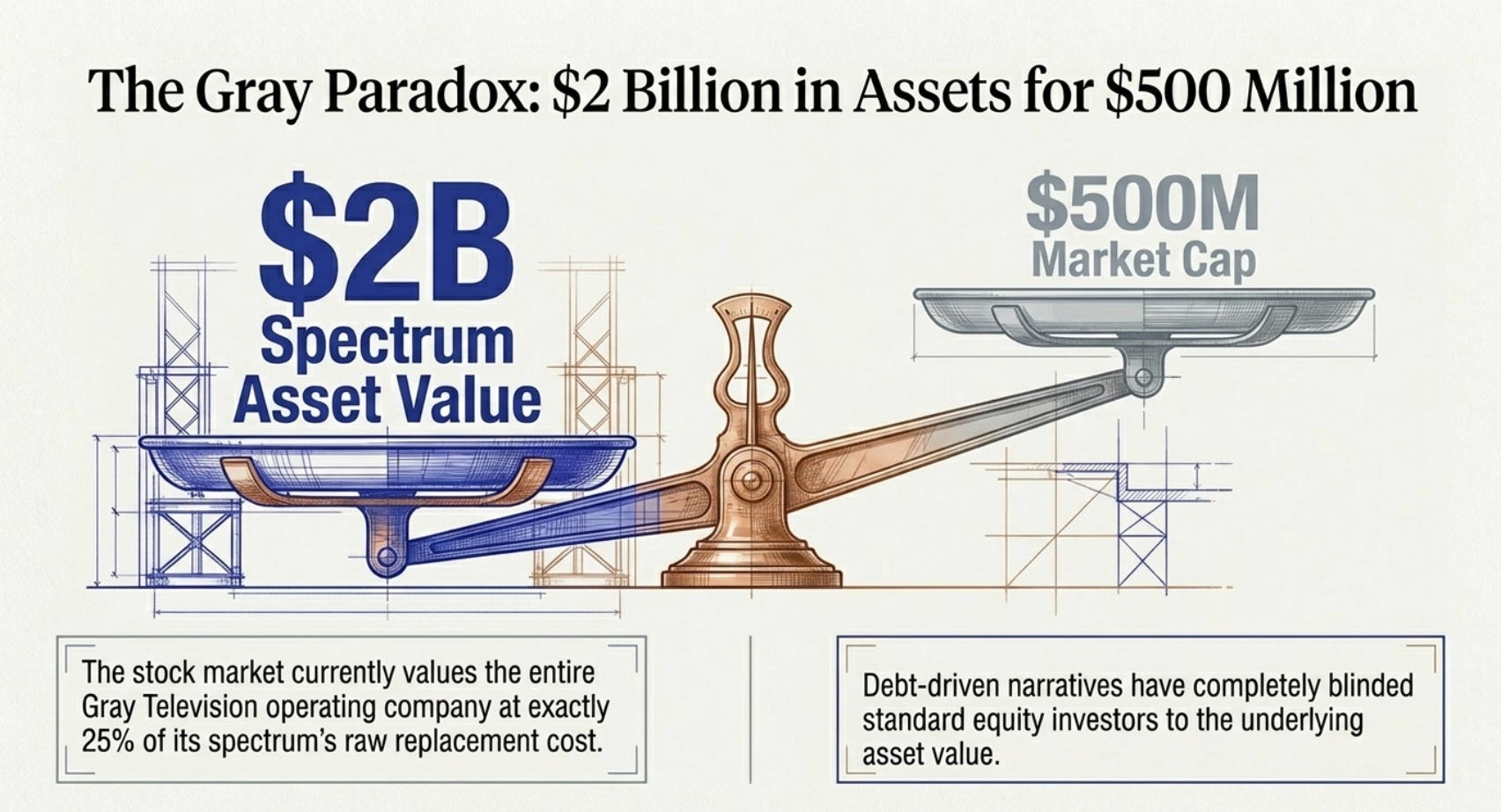
At one point, Gray Television’s market capitalization fell to approximately 400–400–500 million. That figure represented the collective judgment of the stock market about what the entire enterprise — all 180 stations, all their FCC licenses, all their real estate, all their operating businesses, all their retransmission consent agreements, all their network affiliations — was worth.
Yet analysts who took the time to value Gray’s spectrum portfolio on a replacement-cost basis, using the MHz-POP pricing established in the 2017 auction and subsequent private transactions, arrived at a dramatically different number. By some estimates, the spectrum portfolio alone — just the FCC licenses, setting aside all operating assets — was worth in excess of $2 billion.
The company was trading at a 75% to 80% discount to the replacement value of its spectrum. The operating business — $3.6 billion in annual revenue, a portfolio of network affiliations with NBC, CBS, ABC, and FOX, and a growing digital platform — was effectively being assigned a negative value by the market.
Outcome: The Debt Overhang
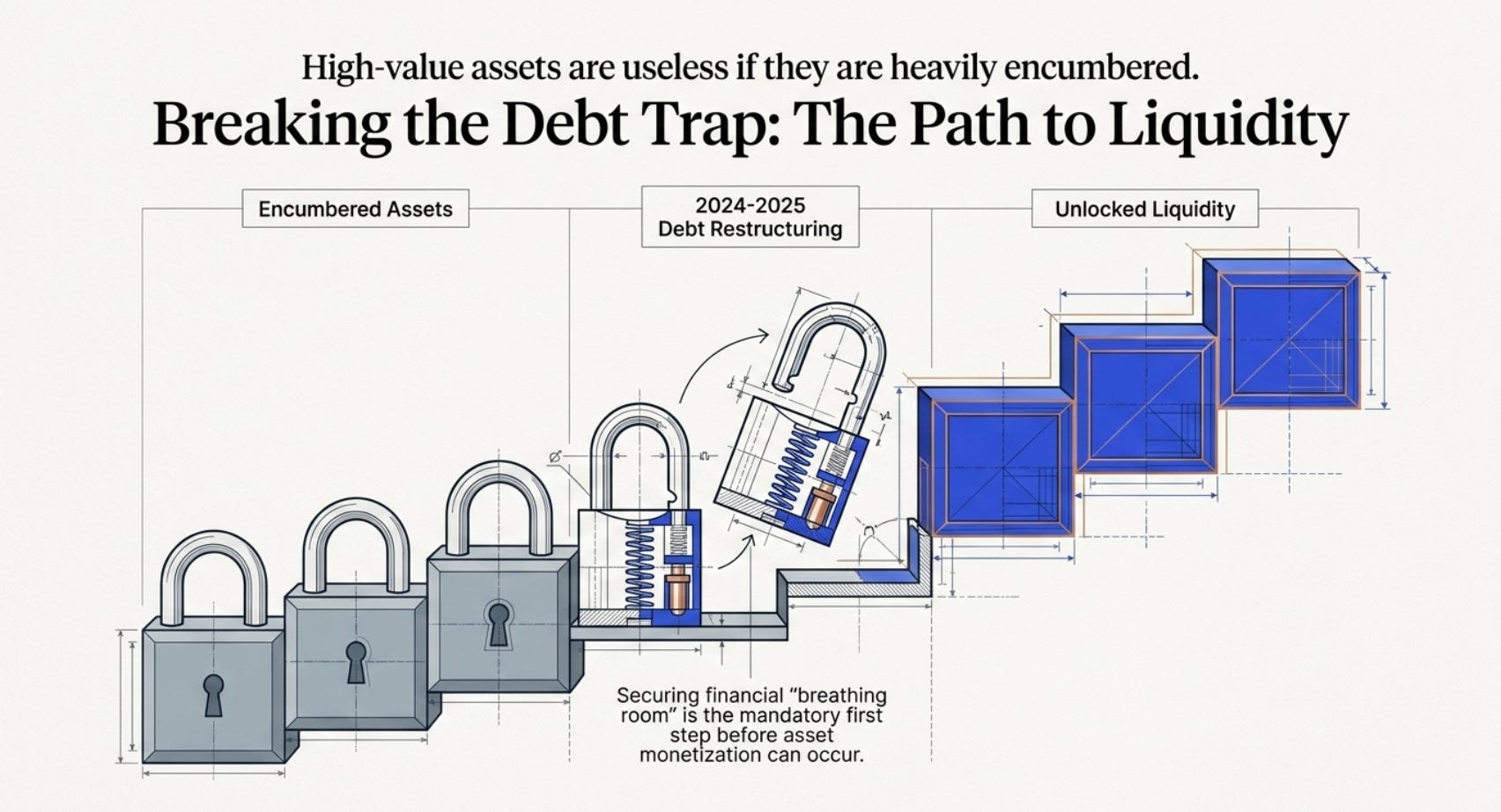
The tragedy of this situation, from a value-realization perspective, is that the discount persisted not because the spectrum was worth less than the analysis suggested, but because Gray’s balance sheet was burdened with debt that constrained its strategic options.
By 2025, Gray was actively restructuring its obligations. The company issued $775 million of senior secured first lien notes due 2033 and $900 million of second lien notes due 2032, extending maturities and reducing near-term refinancing risk. These moves bought time but did not, in themselves, unlock the value embedded in the spectrum portfolio.
The critical lesson from Gray Television is that asset value alone is not sufficient. To realize that value, a company needs either the financial flexibility to pursue monetization opportunities at its own pace, or a catalyst that forces the market to recognize what the assets are worth. Gray had the assets; what it lacked was the breathing room to maximize them.
The situation also underscores a fundamental asymmetry in how different constituencies value the same assets. The bond market was focused on Gray’s leverage ratios, interest coverage, and refinancing risk. The equity market was focused on declining linear television viewership, the lumpiness of political advertising revenue, and cord-cutting headwinds. Neither was focused on the simple question: what would it cost to replicate this spectrum portfolio today? The answer to that question — $2 billion or more — was hiding in plain sight, buried in the gap between historical-cost accounting and current market reality.
The Lesson
A valuable asset encumbered by debt is still valuable — but only when it can unlock its value. The Gray Television experience demonstrates why the business owner’s replacement-cost framework, while essential for understanding what an asset is worth, must be paired with an analysis of “will the undervalued spectrum portfolio remain trap?”.
Case Study: Sinclair And The Edgebeam Catalyst
If Gray Television illustrates the risk of asset value trapped by balance sheet constraints, Sinclair Broadcast Group illustrates the potential for confirmed catalysts to unlock that value.
Development: The Second-Largest Station Group
Sinclair Broadcast Group, founded in 1986 and headquartered in Hunt Valley, Maryland, operates the second-largest portfolio of television stations in the United States, with 185 full-power stations in 86 markets covering approximately 40% of U.S. television households. Like Gray and Nexstar, Sinclair’s FCC licenses sit on its balance sheet at historical acquisition-accounting values that significantly understate their current market worth.
In 2024, Sinclair delivered record financial results: $405 million in political advertising revenue — $876 million in Adjusted EBITDA, representing a 57% jump from 2023. The company’s operational performance was strong. But the stock market, fixated on the secular challenges facing linear television, continued to price Sinclair as a declining business rather than as the holder of a scarce and increasingly valuable spectrum portfolio.
The Birth of EdgeBeam Wireless
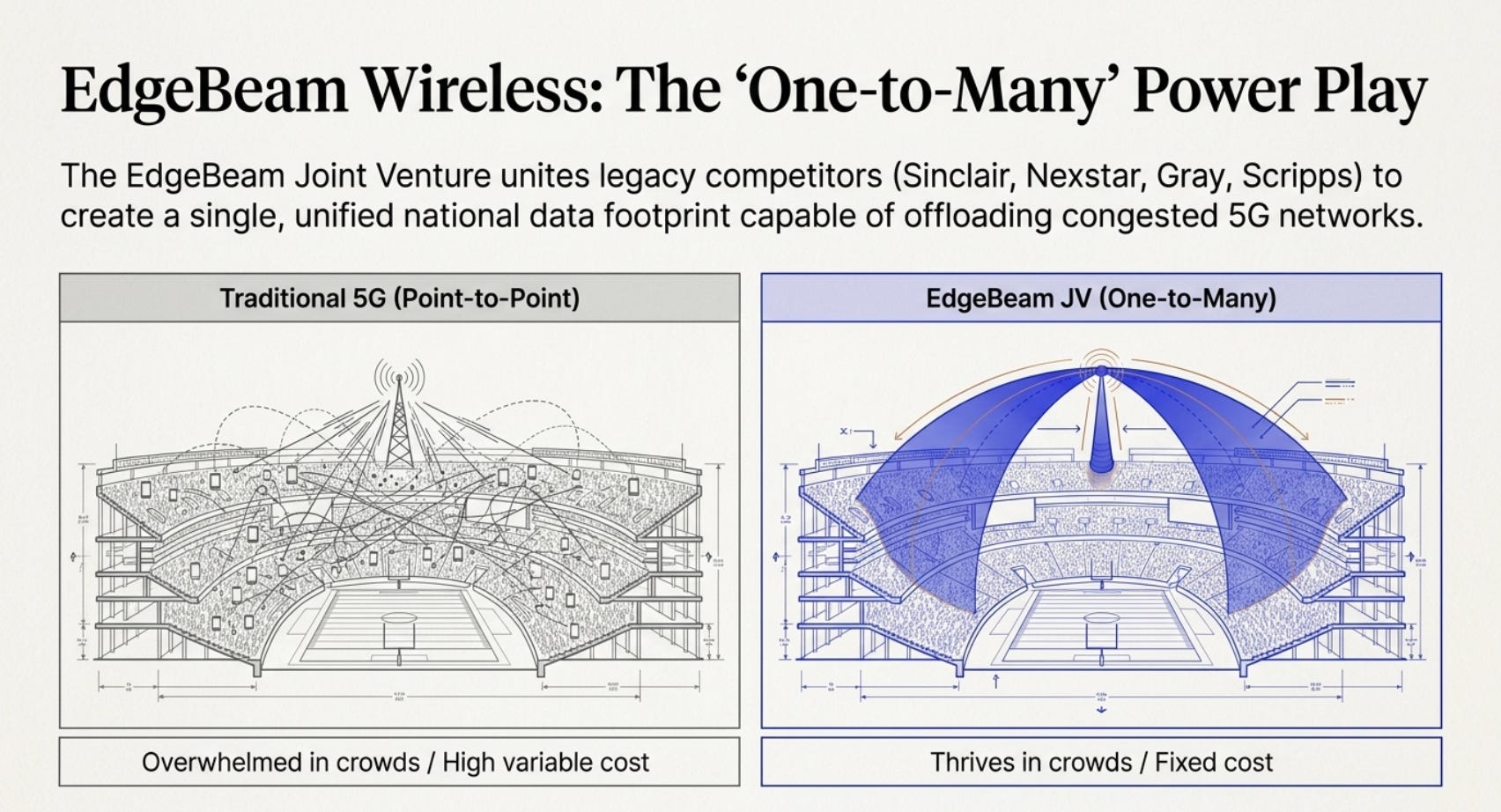
In early 2025, Sinclair, together with Nexstar, Gray Television, and E.W. Scripps — collectively the four largest television station groups in the United States — announced the formation of EdgeBeam Wireless, a joint venture focused on delivering data services using ATSC 3.0 broadcast signals.
This was not a speculative concept paper or a vague expression of interest. It was a concrete business entity, backed by the combined spectrum resources of the four largest broadcasters in the country, with a clear commercial mandate. EdgeBeam’s proposition is straightforward: use the broadcasters’ existing spectrum infrastructure to deliver data — not television programming, but data — to devices, vehicles, and enterprise customers across the United States.
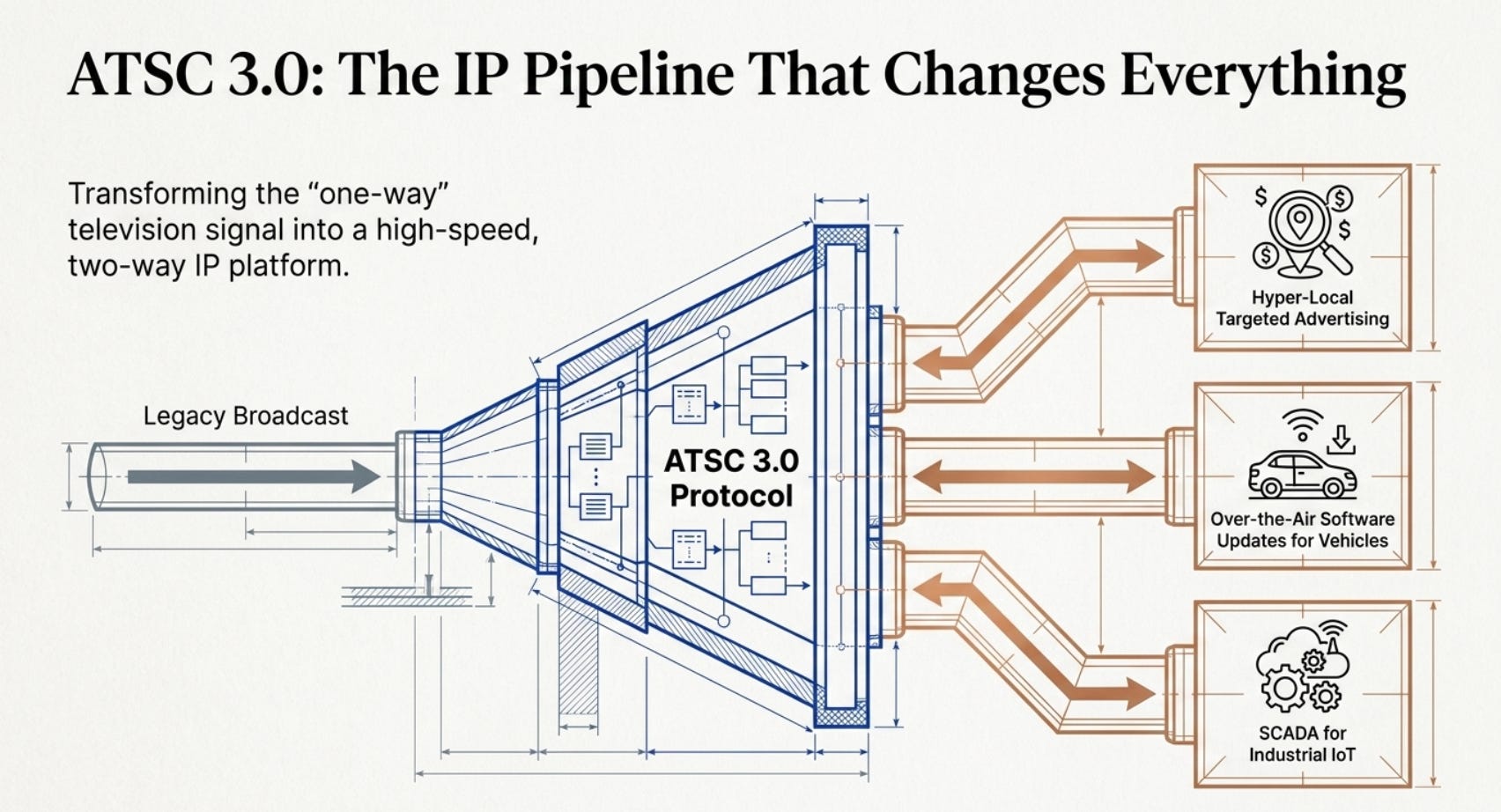
ATSC 3.0, the next-generation broadcast standard, enables capabilities that go well beyond traditional television. It supports targeted advertising, enterprise datacasting, software updates for connected vehicles, and even a broadcast positioning system that could serve as a backup to GPS. The technology transforms broadcast spectrum from a one-way video delivery mechanism into a two-way data platform with applications that the wireless industry has historically dominated.
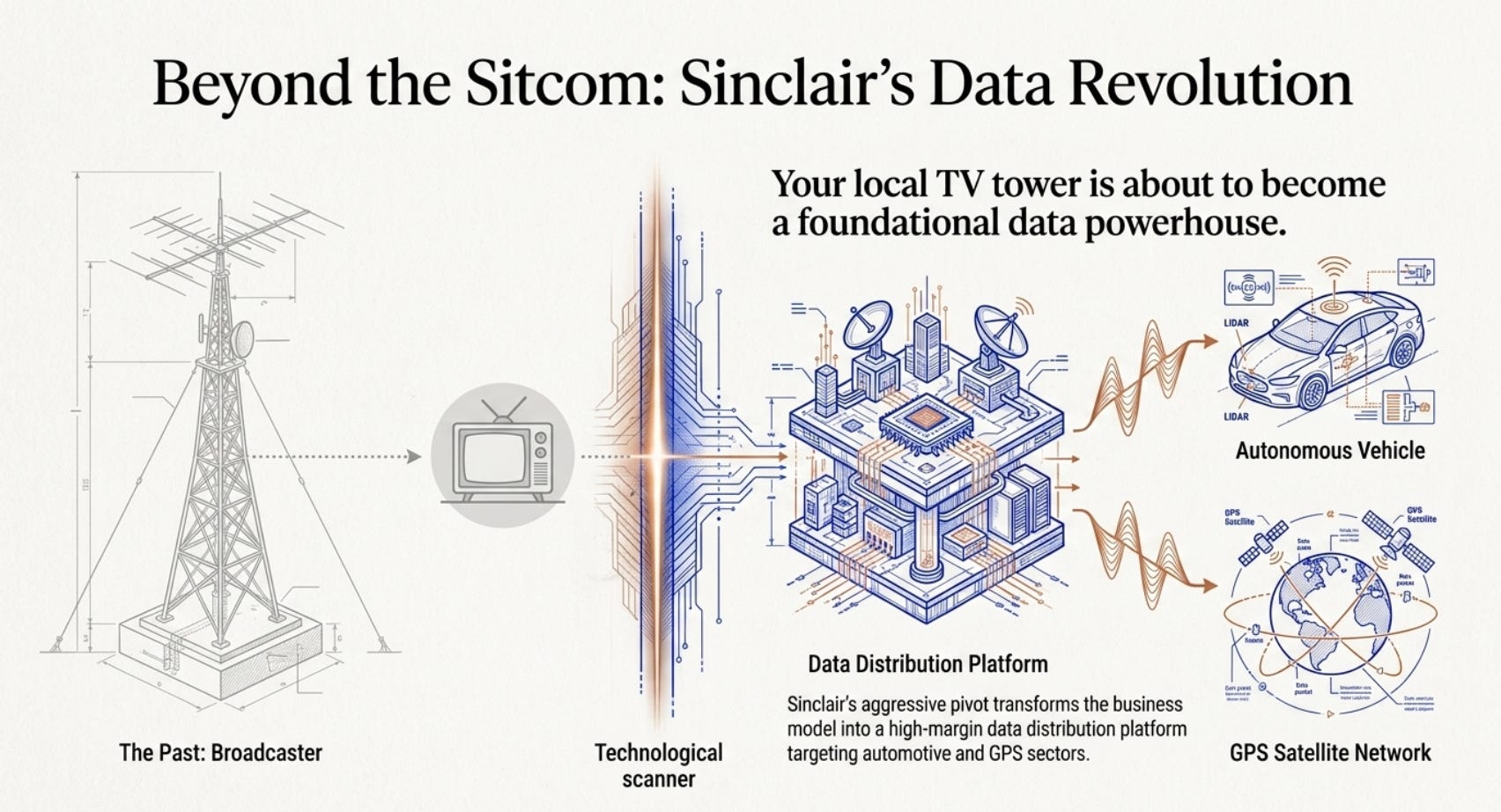
The joint venture structure is significant for several reasons. First, it pools spectrum resources across multiple station groups, creating a nationwide footprint that no single broadcaster could offer on its own — precisely the kind of coverage that wireless carriers and enterprise customers demand. Second, it creates a dedicated vehicle for spectrum monetization that is separate from the broadcasters’ core television operations, allowing investors to value the spectrum business on its own merits. Third, and most importantly, it signals that the broadcasters themselves — the people who understand these assets better than anyone — are actively working to unlock their value. To put it simply:
Imagine the internet is like delivering pizzas:
1. The Wireless Carriers (Verizon, T-Mobile, AT&T)
What they do: They have a fleet of scooters (Cell Towers) that deliver one pizza to one house at a time.
The Problem: This is great for regular orders. But imagine if everyone in the city ordered a pizza at the exact same second (like when everyone downloads the same iPhone update or watches the Super Bowl). The roads get jammed, the scooters get stuck, and nobody gets their pizza on time.
2. Sinclair’s Spectrum (Before EdgeBeam)
What it is: Sinclair owns giant blimps (TV Towers).
Why Carriers didn’t want it:
Wrong Language: The blimps could only drop “TV signals,” not “Internet pizzas.” Carriers couldn’t use them.
Too Small: Sinclair only had blimps in some cities. Carriers need a delivery service that covers the whole country, not just random spots.
Result: The spectrum was useless to carriers because it didn’t fit their system.
3. Enter EdgeBeam (The Magic Translator)
EdgeBeam changed the rules in two ways:
The Translator (ATSC 3.0): EdgeBeam taught the blimps to carry “Internet data” instead of just TV shows. Now, the blimps can drop digital files.
The Team-Up: EdgeBeam got all the other blimp owners (Sinclair, Nexstar, Gray, and Scripps) to join forces. Now, instead of random spots, they have a fleet of blimps covering the entire country.
4. Why Carriers Love It Now
Now, when a carrier needs to send a huge file to millions of people (like a software update for every Tesla), they don’t clog up their scooter fleet.
They pay EdgeBeam to put the file on the blimps.
The blimps fly over the city and drop the file to everyone at once.
The scooters stay free for regular calls and texts.
Why is EdgeBeam a Catalyst?
EdgeBeam is the catalyst because it turned a local, one-way TV signal into a national, data-delivery network. It unlocked value by solving the “congestion” problem that 5G towers physically cannot solve cheaply. It proved that old TV airwaves could do modern internet work.
Will Other Spectrum Owners Get Rich?
Likelihood: High for participation, Low for “selling out” alone.
The “Big Club” Problem: EdgeBeam is already a massive team-up of the four biggest spectrum owners (Sinclair, Nexstar, Gray, Scripps). They control the vast majority of the useful spectrum.
Small Players: If you are a smaller owner of TV spectrum, you likely won’t be able to start your own competitor to EdgeBeam because carriers won’t hire you for just one city.
The Opportunity: Instead of selling their license to a carrier (which is legally difficult), smaller owners will likely lease their spectrum to EdgeBeam. They will get paid to let EdgeBeam use their “blimp” to complete the national network.
Outcome: A Dual-Path Monetization Strategy
Sinclair’s approach to spectrum monetization has evolved into a dual-path strategy. On one path, EdgeBeam Wireless generates recurring revenue from data delivery services, creating an ongoing income stream from spectrum that was previously used solely for broadcast television. On the other path, the possibility of outright spectrum sales — either through future FCC auctions or through private transactions with wireless carriers — remains a powerful option.
A conservative estimate of Sinclair’s spectrum holdings, based on historical auction pricing, suggests its license portfolio could be worth $1 billion or more.
The EdgeBeam development is particularly noteworthy because it represents a confirmed catalyst — not a speculative possibility, not a regulatory proposal that may or may not materialize, but an actual operating entity with committed resources and a defined business plan. This is precisely the kind of development that can narrow, and eventually eliminate, the gap between the replacement value of spectrum assets and the market’s valuation of the companies that hold them.
The Lesson
Spectrum value does not need to be realized through a single transaction. EdgeBeam Wireless demonstrates that broadcasters can unlock the value of their spectrum incrementally — through operating businesses that leverage the spectrum’s data-carrying capacity — while preserving the option for more transformative monetization through future sales or auctions. The key insight is that the spectrum is not an inert asset sitting idle on a balance sheet; it is productive infrastructure capable of generating returns that are not captured by traditional television broadcasting metrics.
The Catalysts
The value arbitrage described in this paper exists because of an accounting framework that systematically understates the economic worth of broadcast spectrum licenses. But value discrepancies can persist indefinitely unless specific catalysts force the market to recognize them. Several such catalysts are now visible on the horizon.
Catalyst 1: ATSC 3.0 and the Data Monetization Paradigm
ATSC 3.0 represents the most significant technological upgrade to broadcast television since the transition from analog to digital. But its implications extend far beyond sharper pictures and better sound. ATSC 3.0 transforms a broadcast tower from a video delivery system into a data distribution platform.
The technology supports IP-based architectures that enable datacasting, personalized content delivery, and advanced metadata that powers dynamic ad insertion. Multi-modal AI can generate rich, scene-level metadata enabling hyper-contextual advertising with measurable increases in effective cost-per-thousand (eCPM) and return on investment. These capabilities allow broadcasters to compete directly with digital platforms for advertising dollars that have migrated away from traditional television.
More significantly, ATSC 3.0 enables entirely new use cases that have nothing to do with television. The standard can support critical infrastructure communications, software updates for autonomous vehicles, public safety paging, and SCADA (Supervisory Control and Data Acquisition) systems for industrial applications. Each of these applications represents a potential revenue stream that leverages existing spectrum assets without requiring additional capital investment in spectrum acquisition.
The EdgeBeam Wireless joint venture — backed by Sinclair, Nexstar, Gray, and Scripps — is the most concrete expression of this catalyst. It is an operational business, not a concept, and its success or failure will be measurable in quarterly revenue numbers within the next several years.
Catalyst 2: The Private Incentive Auction Proposal
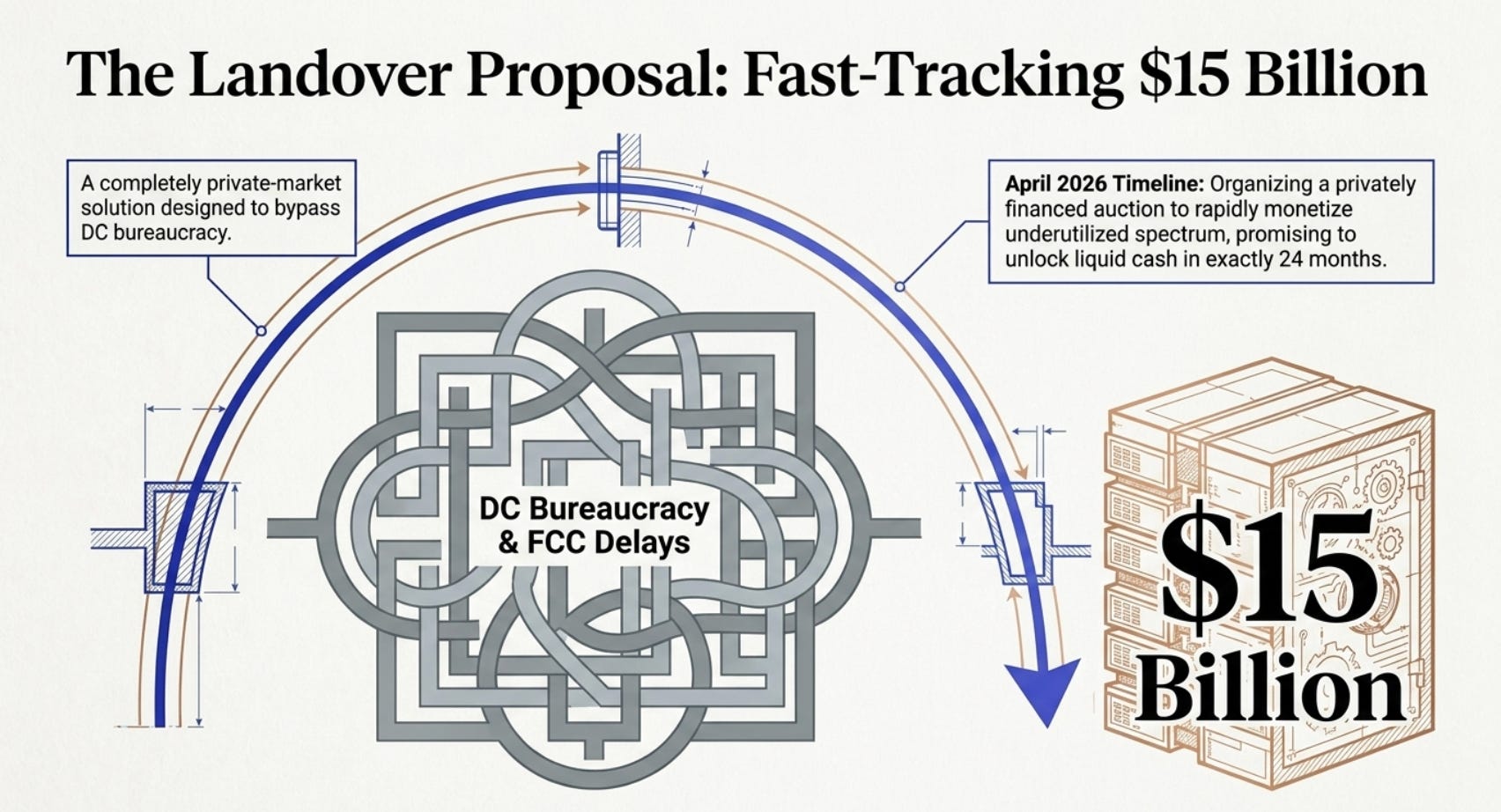
In April 2026, a significant development emerged that could dramatically accelerate spectrum monetization. Landover Wireless proposed a privately financed version of the FCC’s incentive auction — a framework that would be “privately financed and could be completed within approximately 24-36 months” and return more than $15 billion to the U.S. Treasury.
Under this proposal, broadcasters would voluntarily monetize underutilized spectrum in channels 28 through 36 while continuing to deliver their existing television programming. The private financing structure would bypass the cumbersome congressional authorization process that has historically slowed FCC spectrum auctions, potentially compressing the timeline from years to months.
Critically, this proposal targets spectrum that broadcasters are already using less intensively than their primary channels — meaning the monetization would not require broadcasters to cease operations or surrender their core business. It represents a pure value-extraction opportunity from assets that are currently generating little to no incremental return.
Catalyst 3: The EchoStar Precedent
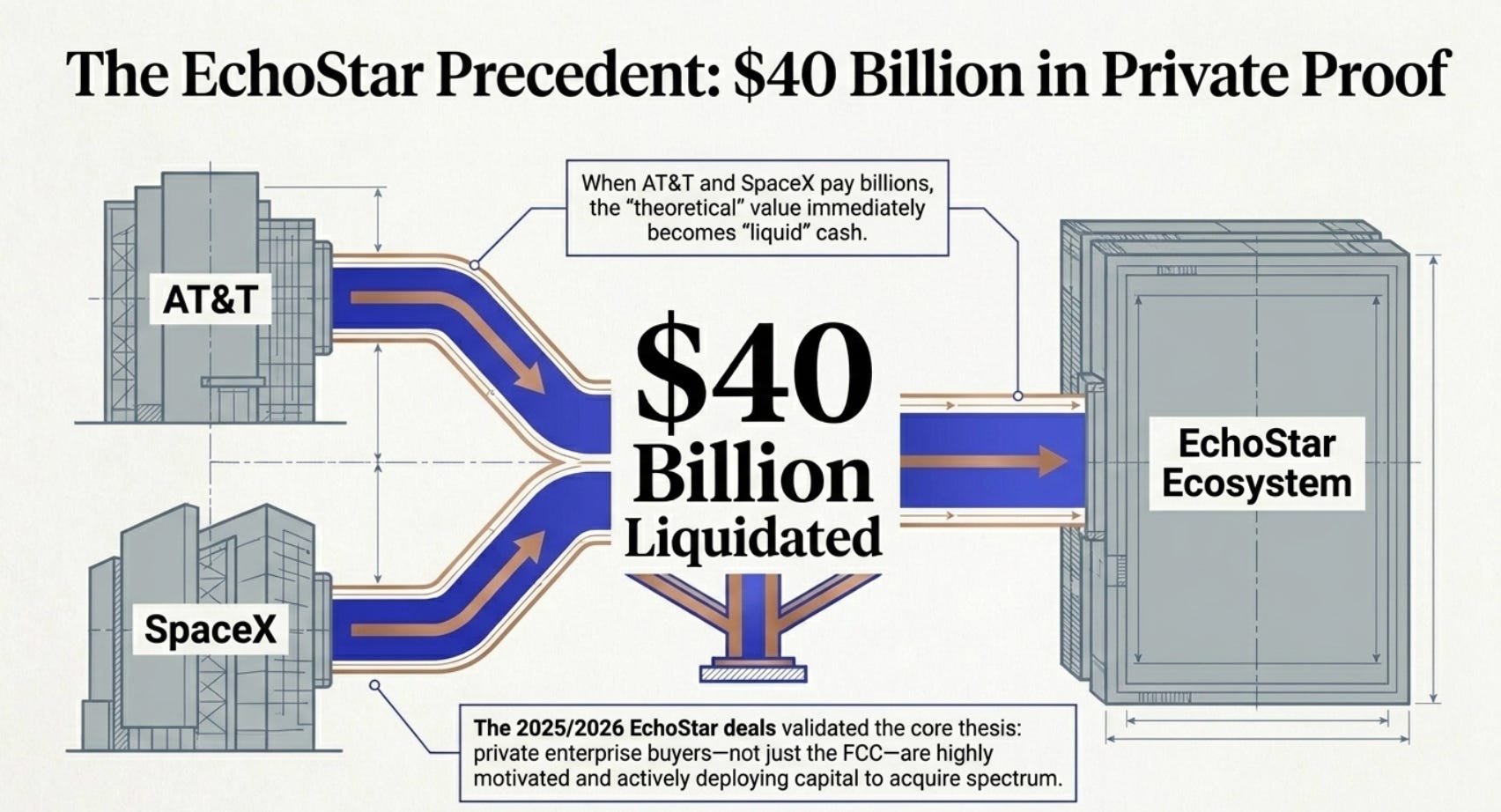
In 2025, EchoStar — the satellite communications company controlled by Charlie Ergen — entered into definitive agreements to sell spectrum licenses to AT&T for $23 billion and to SpaceX (Starlink) for $17 billion — a combined $40 billion in spectrum transactions. The FCC approved these deals in May 2026.
The EchoStar transactions are significant not merely for their scale but for what they demonstrate about the spectrum market. EchoStar’s licenses were not acquired through the 2017 broadcast incentive auction; they were assembled over years through a combination of auction purchases and secondary-market acquisitions. The prices AT&T and SpaceX were willing to pay — $40 billion in aggregate — reflect the intense and growing demand for spectrum rights from companies building next-generation wireless networks.
For television broadcasters, the EchoStar precedent establishes that spectrum does not need to be sold back to the government through an FCC auction to realize its value. Private transactions with strategic buyers — wireless carriers, satellite operators, technology companies — can achieve comparable or superior pricing, with faster timelines and greater certainty of execution.
Catalyst 4: Regulatory Tailwinds Under the Current FCC
The regulatory environment for broadcast spectrum monetization has shifted meaningfully. Under Chairman Brendan Carr, the FCC has signaled openness to policies that would facilitate spectrum transactions and reduce barriers to broadcast ownership consolidation.
Recent FCC actions include approval of the $40 billion EchoStar spectrum sales, advancement of ATSC 3.0 rulemaking that could accelerate the transition to next-generation broadcasting, and consideration of changes to national broadcast ownership caps that would allow station groups to achieve greater scale and operational efficiency.
Commissioner Anna Gomez has publicly acknowledged that broadcasters will derive greater benefit from ATSC 3.0 if the agency raises or eliminates the national ownership cap — a recognition that the regulatory framework needs to evolve to accommodate the technology-driven transformation of the broadcast industry.
The direction of regulatory travel is clear: toward greater flexibility for broadcasters to monetize, consolidate, and repurpose their spectrum assets. This does not guarantee that every broadcaster will maximize the value of its spectrum portfolio, but it removes obstacles that have historically prevented value realization.
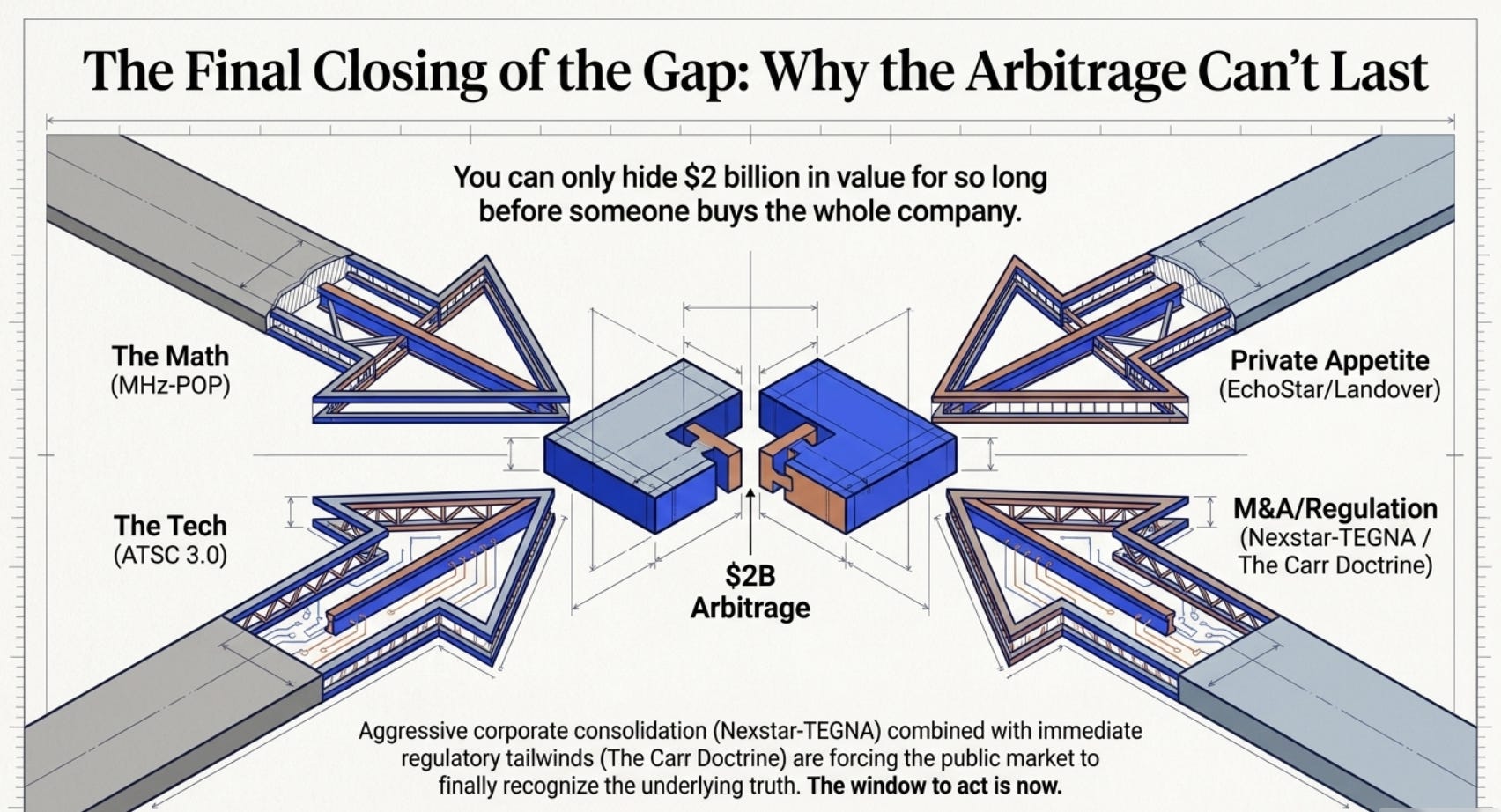
Catalyst 5: Industry Consolidation and the Nexstar-TEGNA Transaction
Consolidation within the broadcasting industry serves as both a catalyst for value realization and a direct demonstration of the value that sophisticated buyers place on spectrum assets.
In 2025, Nexstar Media Group — already the largest television station group in the United States — filed applications with the FCC seeking approval to acquire TEGNA Inc. in a transaction valued at approximately $6.2 billion. The acquisition would further expand Nexstar’s already-substantial spectrum portfolio while creating operational efficiencies through scale.
Nexstar’s willingness to pay $6.2 billion for TEGNA — a price that reflects the value of TEGNA’s FCC licenses, its station operations, its network affiliations, and its retransmission consent agreements — provides a real-world benchmark for what a knowledgeable industry buyer believes these assets are worth. Nexstar management, who understand the spectrum market as well as anyone, are effectively voting with their shareholders’ capital that the public market is undervaluing broadcast assets.
The Lesson: Value Is What Someone Will Pay
The story of broadcast spectrum in America is, at its core, a story about the difference between price and value — between what the accounting rules say something is worth and what a willing buyer would actually pay for it.
The 175 television stations that sold their spectrum in the 2017 incentive auction did not need to convince anyone of this difference. They simply participated in an auction, accepted bids from willing buyers, and collected their proceeds.
The broadcasters who chose not to sell — Nexstar, Gray, Sinclair, TEGNA, Scripps, and others — still hold spectrum that the 2017 auction demonstrated is worth multiples of its carrying value. The question is not whether that value exists; the auction results, the secondary-market transactions, and the EchoStar precedent all confirm that it does. The question is when and how it will be realized.
Several mechanisms for value realization are now in motion. ATSC 3.0 and the EdgeBeam joint venture offer a path to incremental monetization through data delivery services. The Landover private auction proposal offers a path to accelerated spectrum sales without the years-long delays of traditional FCC processes. Industry consolidation — exemplified by Nexstar’s proposed acquisition of TEGNA — offers a path to value realization through strategic transactions at prices that reflect the true worth of the underlying spectrum assets.
The broadcast spectrum that carries local news, network programming, and Sunday football to American households is the same spectrum that carries mobile data to smartphones, connects autonomous vehicles to the cloud, and supports the next generation of wireless applications. The market for that spectrum — as demonstrated by the 2017 auction, the T-Mobile transactions, the C-band auction, and the EchoStar deals — is deep, liquid, and willing to pay prices that bear no relationship to the historical-cost figures on broadcasters’ balance sheets.
The gap will not persist indefinitely. Catalysts are accumulating. The only question is who will own these assets when the gap finally closes.
This white paper is provided for informational and educational purposes only. It does not constitute investment advice, a recommendation, or an offer to buy or sell any security. The author may hold positions in securities discussed. All readers should conduct their own due diligence and consult with qualified financial advisors before making investment decisions. Past auction results and historical transaction data are not guarantees of future pricing. Spectrum values can fluctuate based on regulatory changes, technological developments, and market conditions.
If you like what you’re reading, check out my other writings 👇
Rust, Rigs, and the Recurring Revenue Hidden in Plain Sight: A Deep Dive into Beng Kuang Marine (SGX: BEZ)

The Old Steel and the Sea: Why You Should Care About a Ship Maintenance Company
Investment Reflection #2 — The Grand Play: 100 Years of the World’s Nations as Characters in the Greatest Story Ever Told

“The world is not a chessboard. It is a living organism, where every cell — every nation — eats, competes, cooperates, and occasionally tries to eat the others. Understanding it requires not just memorizing moves, but understanding hunger.”

The Tide Is Going Out: Commodity Houses, Private Credit, and the AI Debt Bomb

Start Here: What This Article Is About
Why I Passed on Graftech (EAF): Riding The Battery Hype, Or Perhaps Not...

There is a kind of company that is the most dangerous thing in investing. It is not the fraudulent company. It is not the obviously bad company with terrible products and incompetent management. Those are easy — you just avoid them. The truly dangerous company is the one with a
The Beautiful Trap: Why I'm Passing on The Hour Glass (SGX: AGS)

There’s a peculiar kind of investment that keeps you up at night — not because it’s bad, but because it’s genuinely good. Good enough to admire. Not good enough to buy.
The Diamond in the Rough That Isn't Quite Yours: Why I Passed on Boustead (SGX: F9D)

There is an old saying that investors have borrowed, bent, and quoted so many times it has nearly lost its sharpness: a bird in the hand is worth two in the bush. Warren Buffett, characteristically, gave it a precise mathematical form. The value of any investment, he wrote, is determined by three questions:
The Schoolteacher's Secret Insurer: Why Horace Mann (NYSE:HMN) Is Sitting on My Watchlist

“The stock market is a device for transferring money from the impatient to the patient.” — Warren Buffett

The Dormitory King That Couldn't Leave Home: Why I Passed on Centurion (SGX: OU8)

There is a deceptively simple question that Warren Buffett borrowed from Aesop’s ancient fable, and has repeated across decades of shareholder letters: “How many birds are in the bush? How sure are you they’re there? And how long until you get them out?”
The Children's Place: A $90 Million Bet on a Company That Used to Be Worth $2 Billion (NYSE: PLCE)

There is a classic scene in every heist movie. The detective walks into a room, sees the chalk outline, the scattered evidence, the broken window, and immediately knows something went terribly wrong long before anyone called the police. You do not need the full autopsy report to read the body.
World War 3 In Iran and Why Oil Price Will Continue Increasing — It Arrived Sooner Than Anyone Expected

This is Part 2 of a continuing analysis of California Resources Corp (CRC). Part 1 built the foundational investment case: a company trading at $44 per share against a conservative intrinsic value of $108–$156, built on 567 million barrels of proved developed oil reserves in California, and a management team spending hundreds of millions buying back its…
The Most Overlooked Oil Company in America — And Why That Might Be the Opportunity of the Decade

Date of analysis: 28 December 2025
The Art Of Saying No - MYPS: Playstudios Inc

PLAYSTUDIOS (MYPS) is a Las Vegas-based mobile gaming company that operates free-to-play social casino games and a loyalty platform called playAWARDS, which lets players redeem points for real-world rewards at places like MGM Resorts, Norwegian Cruise Line, and Wolfgang Puck restaurants. On the surface, this sounds like a clever moat. A loyalty program.…
The Art Of Saying No - UGP: Ultrapar Participacoes S.A (Part 2 of 2)

Question 2: How Certain Are You?
The Art Of Saying No - GLIBK: GCI Liberty Inc

Picture this: a single telecommunications company — the dominant one — serves over 200 communities scattered across the largest state in the United States. Alaska. A state with just over one person per square mile. A state where 39% of residents are underserved by broadband. A state where, until recently, some villages received internet via satellite li…

The Art Of Saying No - UGP: Ultrapar Participacoes S.A (Part 1 of 2)

The Setup: A Value Investor Dream?


The Art of Saying No - RIG: Transocean LTD

“The difference between successful people and really successful people is that really successful people say no to almost everything.” — Warren Buffett
The Art of Saying No - KPRX: Kiora Pharmaceuticals Inc

“The difference between successful people and really successful people is that really successful people say no to almost everything.” — Warren Buffett
The Art of Saying No - DNUT: Krispy Kreme Inc

“The difference between successful people and really successful people is that really successful people say no to almost everything.” — Warren Buffett

🎓 A Business Strategy Primer Part 7 - Learning From Great Companies

The Billion-Dollar Playbook: How Market-Based Management Powered Koch Industries’ Unstoppable Rise
The Art of Saying No - MRX: Marex Group PLC

“The difference between successful people and really successful people is that really successful people say no to almost everything.” — Warren Buffett


The Art of Saying No - SFIX: Stitch Fix Inc

“The difference between successful people and really successful people is that really successful people say no to almost everything.” — Warren Buffett
🎓 A Business Strategy Primer Part 2 - Brainstorming Solutions With Value At The Core

Creating An Irresistible Offer
The Art of Saying No - TDOC: Teladoc Health Inc

“The difference between successful people and really successful people is that really successful people say no to almost everything.” — Warren Buffett

The Art of Saying No - MDU: Mdu Resources Group Inc

“The difference between successful people and really successful people is that really successful people say no to almost everything.” — Warren Buffett


The Art of Saying No - AFCG: Advanced Flower Capital Inc

“The difference between successful people and really successful people is that really successful people say no to almost everything.” — Warren Buffett
The Art Of Saying No - VYX: NCR Voyix Corp

“The difference between successful people and really successful people is that really successful people say no to almost everything.” — Warren Buffett
The Art of Saying No - VSTS: Vestis Corp

“The difference between successful people and really successful people is that really successful people say no to almost everything.” — Warren Buffett

🛢️Basic Energy Primer Part 2 - Business and Competitive Landscape

The Man Who Bet Everything on Being Wrong
The Art of Saying No - CISS: C3is Inc

“The difference between successful people and really successful people is that really successful people say no to almost everything.” — Warren Buffett
The Art of Saying No - PSHG: Performance Shipping Inc

“The difference between successful people and really successful people is that really successful people say no to almost everything.” — Warren Buffett

The Art Of Saying No - MAGN: Magnera Corp

The Magnera Corporation Analysis Nobody Asked For (But Everyone Needs)
The Art of Saying No - CHR: Cheer Holding Inc

“The difference between successful people and really successful people is that really successful people say no to almost everything.” — Warren Buffett
The Art of Saying No - WIMI: WiMi Hologram Cloud Inc.

“The difference between successful people and really successful people is that really successful people say no to almost everything.” — Warren Buffett
⚡️Alternative Energy Primer Part 3 - Industry and Sector Technicals

The €2.2 Billion Mistake That Revealed Everything
⚡️Alternative Energy Primer Part 2 - Business & Competitive Landscape

The Shipwreck That Changed Everything

🏥 A U.S. Health Insurance (Managed Care Organizations) Sector Primer

1️⃣ Industry Fundamentals & Macro View

